Review: Hayato Sumino's Japanese Classical Magic Stuns San Diego
A Unique Musical Experience
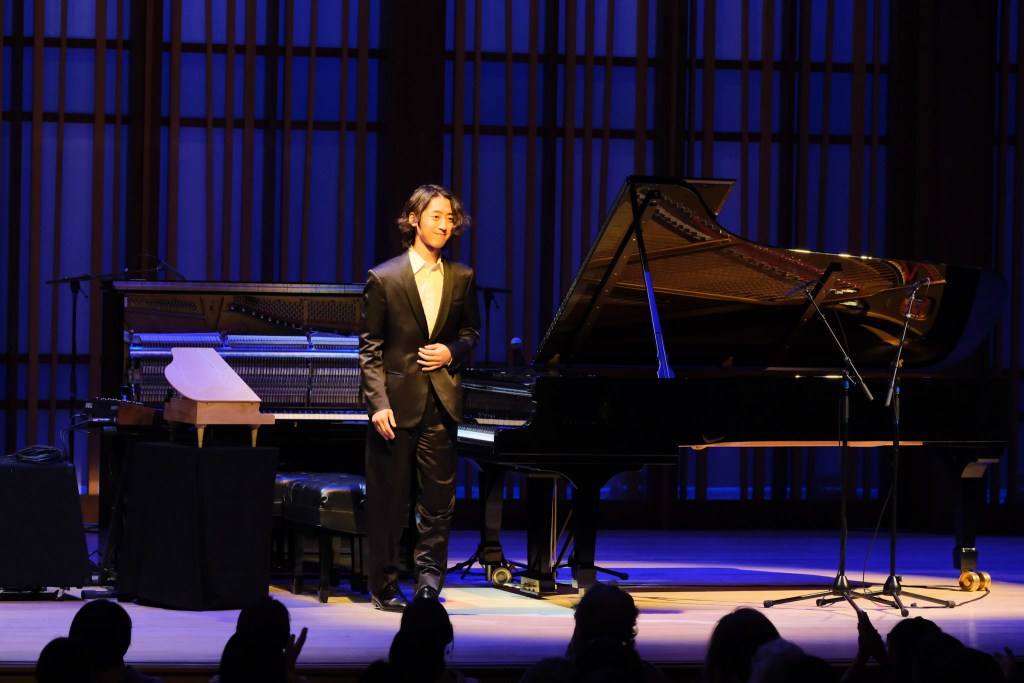
Hayato Sumino made his debut in San Diego on Saturday night, and the event was nothing short of a spectacle. With 1.56 million followers on his YouTube channel Cateen, fans were eager to witness the pianist's performance. However, the concert’s presenter, La Jolla Music Society, faced a challenge due to the intimate seating capacity of their venue. To accommodate the large number of attendees, they opened the nearby JAI venue for viewing via projection screen. This move ensured that no one missed out on the experience.
Sumino, a 30-year-old Japanese pianist, holds a Guinness World Record for indoor piano recital ticket sales, with an impressive 18,564 tickets sold. Despite this, the event was more about creating a memorable experience than just selling tickets. The audience left the concert with a standing ovation, indicating that Sumino's performance was anything but ordinary.
A Diverse Repertoire
Sumino's program featured a mix of classical composers such as Bach, Chopin, Gershwin, and Ravel. However, he is far from being a traditional classical pianist. His background includes a master’s degree in information science and technology from Tokyo Daigaku and studies at Pierre Boulez’s IRCAM in Paris. This unique educational path has shaped his approach to music, allowing him to blend various genres and styles.
Instead of sticking to the classical canon, Sumino has created his own repertoire. He incorporates traditional classical composers, Japanese contemporary artists like Ryuichi Sakamoto and Joe Hisaishi, jazz and pop musicians such as Brad Mehldau and Billie Eilish, and even folk and traditional songs. His compositions often fall into the post-minimalist category, showcasing his innovative spirit.
An Unconventional Stage Setup
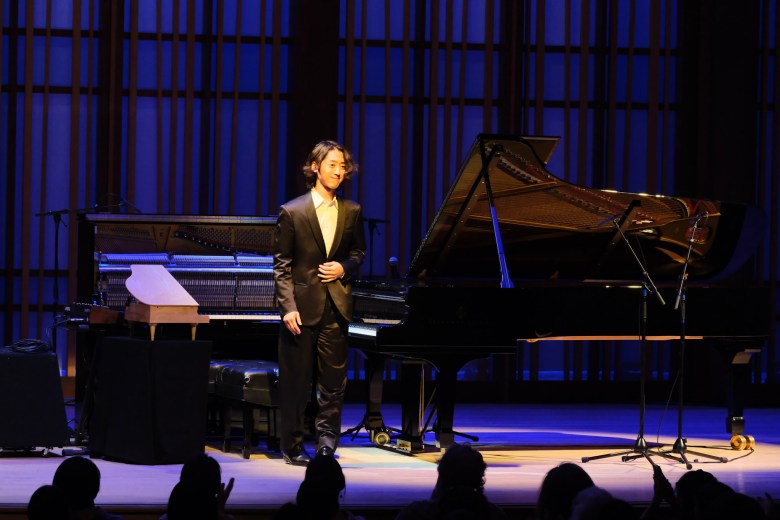
Sumino’s performance setup was as unconventional as his music. On stage at The Conrad, he had a Steinway grand piano to the right, a Steinway upright with its top lid open for prepared-piano techniques in the center, a Sequential Prophet-6 synthesizer to the left, and a Kawai toy piano completing the semicircle. “I’m just happy to be surrounded by as many keyboards as possible,” he joked, highlighting his playful and experimental nature.
A Blend of Tradition and Innovation
Sumino intermixed traditional pieces with his own compositions, which made up a third of the program. He also added his own arrangements of Gershwin’s American in Paris and Ravel’s Boléro. From the start, his performance showcased a fluid, even-fingered touch and attention to each voice. His improvisational flair and narrative flow gave his interpretation of Bach’s Chromatic Fantasia & Fugue in D Minor, BWV 903 a unique quality, infused with elements reminiscent of Rameau.
In the first half of the concert, Sumino transitioned from his own nocturne Once in a Blue Moon to a compelling reading of Chopin’s Nocturne in C Minor. The Chopin Scherzo No. 1 followed, stripped of Romantic embellishments, highlighting Sumino’s ability to make familiar pieces feel fresh and improvised.
Personal Compositions and Performances
Sumino’s own compositions, including New Birth, Recollection, three nocturnes, a jazzy improvisation, and Big Cat Waltz, are melodically engaging and soothing, reminiscent of the New Age style of artists like Sakamoto or Ludovico Einaudi. These works often feature interesting prepared-piano techniques on the upright, such as plucking and muting, creating harp-like pizzicato effects on the exposed strings. The jazzy improvisation that opened the second half showcased these strengths effectively.
However, some of his compositions, particularly his nocturnes and Big Cat Waltz, can sound overly sentimental and derivative. Despite this, Sumino’s overall performance demonstrated a deep understanding of musical expression and innovation.
Mastering Classic Works
The second half of the concert featured Sumino’s playful and orchestral interpretations of two classic pieces: Gershwin’s American in Paris and Ravel’s Boléro. In American in Paris, Sumino used a small keyboard-shaped Suzuki Melodion with an extension-tube mouthpiece to add a Parisian touch. Although his velocity occasionally blurred passagework, his ability to condense a complex orchestral piece into a solo performance earned him a well-deserved ovation.
Sumino truly shone in his rendition of Boléro. Using mutes on the upright’s strings, he created the dry side-drum ostinato that drives the piece forward. He also injected a high-register timbre by playing the toy piano behind his back and captured the instrumental transitions of Ravel’s gradually intensifying crescendo with mastery.
Encores and Final Thoughts
Sumino’s encores included Chopin’s Mazurka Op. 24, No. 2 and Nikolai Kapustin’s Op. 40, No. 3 (Toccatina). While the evening may not have been profound or deeply emotional, it was undeniably successful. As Gershwin once said about American in Paris: “Nothing solemn about it. If it pleases … as a light, jolly piece, it succeeds.”
With his inventive spirit and multifaceted talents, Hayato Sumino proved to be a captivating performer who continues to redefine the boundaries of classical and contemporary music.
